



The CTV landscape in 2026
If you've been parsing CTV traffic lately, you may have spotted something unfamiliar in your logs. In April 2026, Amazon's brand-new Fire TV operating system started turning up in DeviceAtlas data. It announces itself as Kepler/1.1 (Linux; AFTCA002), the same shape Amazon uses as the official example in its Vega developer docs. No Mozilla token, no AppleWebKit, or no Chrome version. If your detection stack last shipped before 2025, it has no idea what to do with it.
This is a prime example of how unpredictable the CTV landscape is in 2026. In May 2025, streaming overtook broadcast and cable combined for the first time, reaching 44.8% of US TV use. Around 90% of US households now use a connected TV at least monthly, and US CTV ad spend will reach roughly $38 billion in 2026, up about 14–15% year on year. The server-side detection layer underneath all of that has to keep up with TV vendors who each write their User-Agent strings however they feel like.
DeviceAtlas covers thousands of distinct Smart TVs and set-top boxes, alongside projectors and games consoles, across 110,000 devices in the database (with 30–40 new devices added every day), exposed via 220+ device properties. This article shows the User-Agent shapes you'll actually see on those devices in 2026.
For the wider list across mobile, desktop, tablets, consoles, e-readers and bots, see our companion post: List of User-Agent strings.
A quick map of the platforms
| Platform | Operating system | Notable brands / devices |
|---|---|---|
| Roku | Roku OS | Roku Ultra, Roku Express, Roku TVs from TCL, Hisense, Sharp |
| Samsung Tizen TV | Tizen | Samsung S95F OLED, QN90F Neo QLED, The Frame 2025 |
| LG webOS | webOS | LG OLED G5/C5, QNED, plus the webOS Hub licensed to other vendors |
| Apple TV | tvOS | Apple TV 4K (3rd gen) |
| Amazon Fire TV | Fire OS (Android-based) | Fire TV Stick 4K, Fire TV Omni QLED |
| Amazon Fire TV (new) | Vega OS | Fire TV Stick 4K Select (2025) and successors |
| Google TV / Chromecast | Android TV / Google TV | Chromecast with Google TV, Google TV Streamer (2024), Sony BRAVIA, TCL Google TV |
| TCL | Roku TV / Google TV / Android TV (no in-house OS) | TCL QM8K, QM7K, C8K, C6K, plus US TCL Roku TVs |
| Hisense VIDAA | VIDAA (proprietary) | Hisense U6N, U7N, U8N (in VIDAA markets) |
| HbbTV (broadcast hybrid) | HbbTV standard (ETSI TS 102 796) | Broadcast-hybrid TVs from Sony, Hitachi, Panasonic, Telefunken, Vestel white-label sets, late-model VIDAA Hisense, etc. |
| PlayStation | PlayStation OS | PlayStation 5, PS5 Pro, PlayStation 4 |
| Xbox | Windows-based | Xbox Series X/S, Xbox One |
Roku and Samsung Tizen are the two most-used connected-TV platforms in US broadband homes, at roughly 28% and 23% respectively (Parks Associates, April 2026). Amazon's Vega OS, at the bottom of the table, replaces Android-based Fire OS on new Fire TV Sticks. Its UA looks nothing like Fire OS did before it.
Quick navigation
- Roku user-agent strings
- Samsung Tizen TV user-agent strings
- LG webOS user-agent strings
- Apple TV user-agent strings
- Amazon Fire TV (Fire OS) user-agent strings
- Amazon Fire TV (Vega OS / Kepler) user-agent strings
- Google TV and Chromecast user-agent strings
- Sony BRAVIA user-agent strings
- TCL user-agent strings
- Hisense VIDAA user-agent strings
- HbbTV (broadcast-hybrid) user-agent strings
- PlayStation and Xbox user-agent strings
- Anatomy of a Connected-TV User-Agent
- What changed in 2026
- Why detect CTV traffic?
Roku user-agent strings
Roku is the single biggest bucket of CTV traffic in DeviceAtlas data for April 2026, and its User-Agent is unusually terse. Sometimes the entire UA is one token.
Two shapes show up in the wild, a bare version and the same with a build suffix:
Roku/DVP-15.2 |
Roku/DVP-15.2 (15.2.4.3429-81) |
Roku/DVP-14.1 (14.1.4.7709-CU) |
Roku/DVP-13.0 (13.0.0.4220-AB) |
Most April 2026 Roku traffic runs Roku OS 15.x; version 15.0 began rolling out in autumn 2025 and was broadly available by mid-November 2025. Every minor version back to Roku OS 10 still shows up. Roku devices stay in service for years; plan for the long tail.
Samsung Tizen TV user-agent strings
Samsung's Tizen TVs report through two distinct User-Agent shapes. The classic Chromium WebView form carries a SamsungBrowser/<n>.0 token alongside the Tizen version. The second shape is a stripped Tizen-only token used by the platform's own apps.
Observed in DeviceAtlas data for April 2026:
Mozilla/5.0 (SMART-TV; Linux; Tizen 9.0) AppleWebKit/537.36 (KHTML, like Gecko) SamsungBrowser/8.0 Chrome/120.0.6099.5 TV Safari/537.36 |
Mozilla/5.0 (SMART-TV; Linux; Tizen 6.0) AppleWebKit/537.36 (KHTML, like Gecko) SamsungBrowser/4.0 Chrome/120.0.6099.5 TV Safari/537.36 |
Mozilla/5.0 (SMART-TV; Linux; Tizen 9.0) |
Mozilla/5.0 (SMART-TV; Linux; Tizen 5.5) AppleWebKit/537.36 (KHTML, like Gecko) SamsungBrowser/3.0 Chrome/94.0.4606.31 TV Safari/537.36 |
Official template, from Samsung's User-Agent string format reference:
Mozilla/5.0 (SMART-TV; Linux; Tizen 2.3) AppleWebKit/538.1 (KHTML, like Gecko) SamsungBrowser/1.0 TV Safari/538.1 |
Mozilla/5.0 (SMART-TV; Linux; Tizen 2.2; SAMSUNG SM-Z910F) AppleWebKit/537.3 (KHTML, like Gecko) Version/2.2 TV Safari/538.1 |
Tizen 5.5 shipped on Samsung's 2020 TVs and still produces real traffic in 2026. Tizen 10 ships on Samsung's 2026 TV lineup; pre-release units have been visible in DeviceAtlas data since August 2025. If your detection table only knows Tizen 8 and 9, you'll misclassify both ends of the deployed base.
LG webOS user-agent strings
LG's webOS TVs identify themselves as Web0S; Linux/SmartTV. The zero in Web0S is not a typo. Embedded-app launches append WebAppManager; the platform browser itself drops it. LG documents the Chromium-based engine in the webOS TV Web Engine specification.
Mozilla/5.0 (Web0S; Linux/SmartTV) AppleWebKit/537.36 (KHTML, like Gecko) Chrome/120.0.6099.270 Safari/537.36 WebAppManager |
Mozilla/5.0 (Web0S; Linux/SmartTV) AppleWebKit/537.36 (KHTML, like Gecko) QtWebEngine/5.2.1 Chrome/38.0.2125.122 Safari/537.36 WebAppManager |
Mozilla/5.0 (Web0S; Linux/SmartTV) |
webOS 25, which LG back-ported to its 2022 and 2023 model years in late 2025, keeps the same UA shape. What you can read off it is the Chromium version baked into the firmware build.
Apple TV user-agent strings
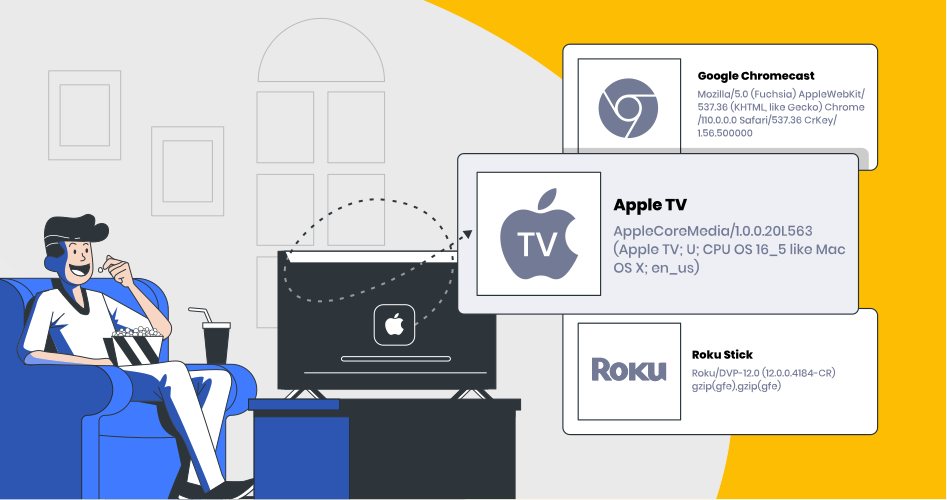
Apple TV traffic comes in two complementary patterns. Media-engine traffic uses AppleCoreMedia/… with (Apple TV; …; CPU OS <ver> like Mac OS X). Apps frequently identify themselves with a bundle-id-prefixed form; Google's IMA SDK for tvOS is one common source: com.google.tvos.GoogleInteractiveMediaAds/4.14.1 (Apple TV; CPU OS 26_4 like Mac OS X), PrimeVideo/2.9.1 (AppleTV6,2; tvOS 26.4; Scale/2.0).
AppleCoreMedia/1.0.0.23L5443g (Apple TV; U; CPU OS 26_5 like Mac OS X; en_gb) |
AppleCoreMedia/1.0.0.22J357 (Apple TV; U; CPU OS 18_0 like Mac OS X; en_us) |
com.google.tvos.GoogleInteractiveMediaAds/4.14.1 (Apple TV; CPU OS 26_4 like Mac OS X) |
PrimeVideo/2.9.1 (AppleTV6,2; tvOS 26.4; Scale/2.0) |
If you care about CTV ad attribution, the app-prefixed shape is the one you want. It tells you which app made the request.
Amazon Fire TV (Fire OS) user-agent strings
Amazon Fire TV on Fire OS is Android underneath. The UAs look like Android WebView strings with an AFTxxx model code in the build tag. Amazon publishes the canonical UA template per Fire TV browser surface and a separate model-code reference for every AFTxxx code in the wild.
Observed in DeviceAtlas data for April 2026:
Mozilla/5.0 (Linux; Android 11; AFTKM) AppleWebKit/537.36 (KHTML, like Gecko) Silk/146.1.122 like Chrome/146.0.7680.165 Safari/537.36 |
Mozilla/5.0 (Linux; Android 9; AFTSS) AppleWebKit/537.36 (KHTML, like Gecko) Silk/138.13.4 like Chrome/138.0.7204.244 Safari/537.36 |
Mozilla/5.0 (Linux; Android 5.1.1; AFTT Build/LVY48F; wv) |
Mozilla/5.0 (Linux; Android 9; AFTKA) |
Official templates, from Amazon's Fire TV User-Agent Strings docs:
Mozilla/5.0 (Linux; U; Android <android>; <locale>; <device> Build/<build>) AppleWebKit/<webkit> (KHTML, like Gecko) Version/4.0 Mobile Safari/<safari> |
Mozilla/5.0 (Linux; Android <android>; <device> Build/<build>) AppleWebKit/<webkit> (KHTML, like Gecko) Chrome/<chrome> Mobile Safari/<safari> |
Mozilla/5.0 (Linux; Android <android>; <device> Build/<build>) AppleWebKit/<webkit> (KHTML, like Gecko) Chrome/<chrome> Mobile Safari/<safari> cordova-amazon-fireos/<amazon> AmazonWebAppPlatform/<amazon> |
Look at the model token. AFTKM, AFTSS, AFTT, AFTKA, AFTSSS, AFTKRT, and so on. Every Fire TV generation has its own code, and DeviceAtlas maps each one back to a specific product.
Amazon Fire TV (Vega OS / Kepler) user-agent strings
This is the one we've been watching most closely in 2026. Vega OS is Amazon's Linux + React Native operating system for Fire TV, on devices like the Fire TV Stick 4K Select (AFTCL001). It first appeared in DeviceAtlas data in July 2025 and shipped broadly from October 2025 on the Fire TV Stick 4K Select, replacing the Android-based Fire OS on new devices. The runtime token in the User-Agent is Kepler (formerly Amazon's internal codename for the developer tooling). Its UA shape is unlike anything Fire OS ever produced. Amazon's WebView development best practices for TV page covers the WebView form in particular.
Observed in DeviceAtlas data for April 2026 (the user/<id> segment is the per-process identifier Amazon's docs render as user/1234):
Kepler/1.1 (Linux; AFTCL001) |
Mozilla/5.0 (Linux; Kepler 1.1; AFTCA002 user/1234; wv) AppleWebKit/537.36 (KHTML, like Gecko) Mobile Chrome/132.0.6834.209 Safari/537.36 |
Amazon AFTCA002 Kepler/1.1 espn/2026.3.1 NativeClientPlatform/2025.09.10 |
Amazon AFTCA002 Kepler/1.1 Hulu/1.43.0 NativeClientPlatform/2025.09.8 |
Official examples, from Amazon's react-native-device-info getUserAgent() and WebView development best practices for TV docs:
Kepler/1.1 (Linux; AFTCA002) |
Mozilla/5.0 (Linux; Kepler 1.1; AFTCA002 user/1234; wv) AppleWebKit/537.36 (KHTML, like Gecko) Mobile Chrome/130.0.6723.192 Safari/537.36 |
The first form drops the entire Mozilla/AppleWebKit/Chrome ceremony. The second keeps it. The third is what individual apps emit through Vega's React Native runtime: vendor, model code, Kepler version, app name, app version, all on one line.
DeviceAtlas already classifies Kepler correctly: Set Top Box, Amazon, Vega 1.1, model code intact. If your stack hasn't been updated since 2024, it won't.
Google TV and Chromecast user-agent strings
Modern Chromecast with Google TV, the Google TV Streamer (2024), and most Google-TV partner sets (Sony, TCL, Hisense in some markets) run Android 14. So the UA is a standard Android WebView line with a recognizable model token: Chromecast HD, Google TV Streamer, or plain Chromecast.
Mozilla/5.0 (Linux; Android 14; Chromecast HD Build/UTTC.250917.004; wv) AppleWebKit/537.36 (KHTML, like Gecko) Version/4.0 Chrome/146.0.7680.177 Mobile Safari/537.36 |
Mozilla/5.0 (Linux; Android 14; Google TV Streamer Build/UTTK.250729.004; wv) |
Mozilla/5.0 (Linux; Android 14; Chromecast Build/UTTC.250917.004; wv) |
Older non-Google-TV Chromecasts (the 1st/2nd/3rd-gen pucks running Fuchsia) carry a CrKey/… token instead.
Sony BRAVIA user-agent strings
Sony's BRAVIA Smart TVs run Android TV with the BRAVIA model name in the Build token. You can read the specific Sony BRAVIA range straight off the UA.
Mozilla/5.0 (Linux; Android 14; BRAVIA VU31 Build/UKR1.240726.001; wv) |
Mozilla/5.0 (Linux; Android 12; BRAVIA VH1 Build/STT2.230505.001.S101; wv) |
Mozilla/5.0 (Linux; Android 9; BRAVIA 4K GB Build/PTT1.190515.001.S54; wv) |
TCL user-agent strings
TCL is one of the world's largest TV brands, trading second and third place with Hisense behind Samsung. Unlike Samsung, LG, Sony or Hisense, TCL doesn't ship its own TV OS: every TCL set runs someone else's platform. In the US most TCL sets are Roku TVs; in the EU and Asia they're Google TV / Android TV; older models ran AOSP Android TV. The brand is therefore split across two of the sections above, and you can't always tell a TCL TV from its UA.
TCL Google TV / Android TV sets do surface a TCL TV model token in the Android WebView build tag:
Mozilla/5.0 (Linux; Android 12; TCL TV Build/TQ1A.230205.002; wv) |
Mozilla/5.0 (Linux; Android 11; TCL TV Build/RP1A.200720.011; wv) |
Mozilla/5.0 (Linux; Android 9; TCL TV Build/QT.200305.002; wv) |
TCL Roku TVs, by contrast, send the standard Roku/DVP-… User-Agent, with no TCL token anywhere in it. To distinguish a TCL Roku set from any other Roku, you need the underlying device record, not the UA.
Hisense VIDAA user-agent strings
VIDAA is Hisense's proprietary, non-Android operating system. It is also licensed to Toshiba and Sharp in some markets. The trailing VIDAA/<ver>(Hisense;SmartTV;<model>;<chipset>/<firmware>;<resolution>;<sales-model>;) block carries the model, chipset, firmware, panel resolution and sales designation in a single header.
Mozilla/5.0 (X11; Linux armv7l) AppleWebKit/537.36 (KHTML, like Gecko) Chrome/111.0.5563.146 Odin/111.5563.5.1 Safari/537.36 Model/VIDAA-MTK9603 VIDAA/9.0(Hisense;SmartTV;65E70LEVS;MTK9603/V0000.09.09R.P0930;UHD;65E7LE;) |
Mozilla/5.0 (X11; Linux armv7l) AppleWebKit/537.36 (KHTML, like Gecko) Chrome/111.0.5563.146 Odin/111.5563.5.1 Safari/537.36 Model/VIDAA-MT9602 VIDAA/9.0(Hisense;SmartTV;65A53FEVS;MTK9602/V0000.09.09A.P0930;UHD;65A5FE;) |
You can identify the exact Hisense model and firmware from one header. It's dense but informative.
HbbTV (broadcast-hybrid) user-agent strings
HbbTV (Hybrid Broadcast Broadband TV, ETSI TS 102 796) is a pan-European standard for TV sets that pull broadcast and broadband content side by side: red-button interactive overlays, catch-up, EPG enrichments. It's not a brand; it's a marker any compliant TV adds to its existing UA. Look for the HbbTV/<version> token. Common versions: HbbTV/1.0.0, 1.1.1, 1.2.1, 1.3.1, 1.5.1. The HbbTV consortium publishes the device capabilities and UA conventions in its developer guide.
HbbTV produces a long tail of UAs in DeviceAtlas data for April 2026, partly because of the Vestel-made white-label sets sold under Telefunken, Hitachi, Panasonic and similar nameplates:
Mozilla/5.0 (Linux armv7l) AppleWebKit/537.36 (KHTML, like Gecko) Chrome/44.0.2403.130 Safari/537.36 OPR/31.0.1890.0 OMI/4.6.1.40.Dominik2.0 VSTVB MB100 HbbTV/1.2.1 (; TELEFUNKEN; MB110; 2.9.8.0; ;) SmartTvA/3.0.0 |
Mozilla/5.0 (Linux armv7l) AppleWebKit/537.36 (KHTML, like Gecko) Chrome/38.0.2125.122 Safari/537.36 OPR/25.0.1620.0 OMI/4.3.18.7.Dominik.0 VSTVB MB100 HbbTV/1.2.1 (; PANASONIC; MB100; 0.1.34.5; ;) SmartTvA/3.0.0 |
Mozilla/5.0 (Linux; Andr0id 10; BRAVIA 4K VH22) AppleWebKit/537.36 (KHTML, like Gecko) Chrome/84.0.4147.125 Safari/537.36 OPR/46.0.2207.0 OMI/4.21.0.273.DIA6.234 HbbTV/1.5.1 (+DRM; Sony; KD-43X75WL; PKG6.7480.0852EUA; ; com.sony.HE.G4.4K; ) sony.hbbtv.tv.G4.2023HE.4K LaTivu_1.0.1_2023 |
Mozilla/5.0 Cobalt/23.0.0.0 skia Starboard/14 HbbTV/1.0.0 FVC/9.0 LaTivu_2.0.0_2024 VIDAA-MTK9618 VIDAA/U9.0 |
Things to read off the HbbTV block: vendor (TELEFUNKEN, PANASONIC, HITACHI, Sony), the Vestel-board generation (MB100, MB110; Vestel makes the hardware for many of these brand names), firmware version, and HbbTV revision. The OPR/ token is Opera, the embedded HbbTV browser on most non-Cobalt sets; Cobalt + Starboard is YouTube's CTV runtime, which is starting to show up on Hisense / VIDAA HbbTV sets too. The Sony BRAVIA example has both forms in one line: an Android WebView vendor block plus the HbbTV tail.
PlayStation and Xbox user-agent strings
Both major consoles browse the web with their own User-Agent. Sony's PlayStation 5 rides on Apple's Safari engine; Microsoft's Xbox Series X piggybacks on Edge.
Mozilla/5.0 (PlayStation; PlayStation 5/13.00) AppleWebKit/605.1.15 (KHTML, like Gecko) Version/17.0 Safari/605.1.15 |
Mozilla/5.0 (PlayStation; PlayStation 4/13.50) AppleWebKit/605.1.15 (KHTML, like Gecko) Version/17.0 Safari/605.1.15 |
Mozilla/5.0 (Windows NT 10.0; Win64; x64; Xbox; Xbox One) AppleWebKit/537.36 (KHTML, like Gecko) Chrome/114.0.0.0 Safari/537.36 Edge/44.18363.8131 |
Anatomy of a Connected-TV User-Agent
Most CTV UAs decompose into the same handful of tokens. Take this LG webOS string:
Mozilla/5.0 (Web0S; Linux/SmartTV) AppleWebKit/537.36 (KHTML, like Gecko) Chrome/120.0.6099.270 Safari/537.36 WebAppManager |
| Token | What it means |
|---|---|
Mozilla/5.0 |
Legacy compatibility token. Every modern browser ships it. Ignore. |
(Web0S; Linux/SmartTV) |
The vendor block. Web0S identifies LG webOS specifically. Linux/SmartTV is the device-class hint. |
AppleWebKit/537.36 (KHTML, like Gecko) |
Layout engine. Effectively a constant across all Chromium-based browsers. |
Chrome/120.0.6099.270 |
Chromium version embedded in the platform browser. Useful as a rough age signal. |
Safari/537.36 |
More Chromium boilerplate. Ignore. |
WebAppManager |
This is the part that matters. It says the request came from a webOS embedded app, not the platform browser. |
The same pattern repeats across CTV platforms. A Mozilla/5.0 (…) vendor block at the front, the constant Chromium pile in the middle, and one or two platform-specific tokens at the end: WebAppManager, SamsungBrowser/x.0, Silk/x.x like Chrome/…, CrKey/…, VIDAA/x.0(…), HbbTV/x.x.x (; <vendor>; …). The platform-specific tokens are the part you actually need to detect on.
For the token-by-token walkthrough of one of the more surprising recent changes (the Linux; Android <ver>; K placeholder Chromium now puts in mobile Android WebViews), see What is "Linux; Android 10; K"?
What changed in 2026
Three things worth checking if your CTV detection hasn't been updated since 2024.
Vega OS
Discussed above in more detail. New Amazon operating system, new UA shape, already in production traffic.
The Linux; Android <ver>; K placeholder is a mobile problem
Chromium has been stripping the device-model token from Android WebView UAs since 2023, replacing it with the literal K. We expected the placeholder to bleed into CTV traffic by now, but it hasn't.
DeviceAtlas data for April 2026 carries zero CTV User-Agents with the K placeholder. The Google-TV and Android-TV WebViews still pass through their real model token (Chromecast HD, Google TV Streamer, BRAVIA VU31). That may change as those WebViews catch up with mobile Chrome, but for 2026 the K-placeholder problem is squarely a mobile one, not a CTV one.
Client Hints have not arrived on CTV
User-Agent Client Hints (UA-CH) arrived on mobile and desktop years ago. On CTV they're still rare. The CTV platforms where we see any Sec-CH-UA-* headers in 2026 traffic are:
- Amazon Fire TV. Fire OS's Silk browser ships current Chromium (Chrome 138, 142, 146 in the examples earlier), and current Chromium emits Sec-CH-UA by default.
- Android-TV partner sets and STBs: Sony BRAVIA, Changhong, Skyworth, a few others. Whenever a partner set happens to bundle a recent enough Chromium WebView, Client Hints come along for the ride.
Where they don't appear: Roku (custom non-Chromium player); Apple TV (WebKit / Safari, with only partial Client Hints support); Samsung Tizen and LG webOS (each ships an older Chromium build in its platform browser, older than the version that enabled Sec-CH-UA by default).
Client Hints adoption on CTV isn't really about which vendor decided to ship them. It tracks how recent the Chromium build embedded in the platform browser happens to be. Fire TV's Silk is the newest, so it shows the most CH headers; Amazon didn't "integrate" Client Hints, it inherited them from a current Chromium.
A real Amazon Fire TV request with Client Hints looks like this:
User-Agent: Mozilla/5.0 (Linux; Android 11; AFTMA475B1) AppleWebKit/537.36 (KHTML, like Gecko) Silk/146.3.4 like Chrome/146.0.7680.165 Safari/537.36
Sec-CH-UA: "Not-A.Brand";v="24", "Chromium";v="146"
Sec-CH-UA-Mobile: ?0
Sec-CH-UA-Platform: "Android"
Even on Fire TV only the lower-entropy hints come through. The richer Sec-CH-UA-* headers that desktop Chromium fills in (model, full-version-list, architecture, bitness, platform-version) are empty or absent. The User-Agent string is still the primary CTV signal in 2026.
Why detect CTV traffic?
Accurate CTV identification matters for codec and bitrate selection: H.264, H.265, VP9 and AV1 support varies per device, and getting it wrong means streams that won't play. Other reasons: CTV ad targeting and OpenRTB device-object enrichment, FAST channel personalization, ad-fraud filtering. DeviceAtlas exposes 220+ device properties across 110,000 devices, including the CTV-specific identifiers needed for those decisions: primary hardware type, vendor, model, firmware version, codec support, screen geometry.
"We do occasionally get organizations contacting us saying, 'Can you please recognize our device as CTV because we make more money.' Our commitment to the industry is we tell them exactly what the device is."
— John Leonard, Director of Product Strategy at DeviceAtlas, at the IBC 2025 panel "Making advertising more viewer-centric"
Download a summary of the List of Smart TV User-Agent Strings blog.
If you’d like to learn more, check out our other blogs:
- How Well Do You Know Your CTV Traffic?
- Why CTV Apps Should Use Device Intelligence To Identify Devices
- The CTV Identity Crisis: What Pixalate's Report Reveals About Bundle IDs
- Leveraging Device Intelligence For Video Monetization
- Solving The CTV User-Agent Problem
For developers: paste any of the User-Agent strings above into the DeviceAtlas HTTP Headers Parser to see what properties DeviceAtlas extracts.