





The digital landscape is growing fast with over 31 billion devices expected to be in the market by 2030. The proliferation of disparate device types across the market has made for an ever more fragmented device landscape. Thus, knowledge of these devices and their capabilities is critical for businesses who operate at scale and strive to deliver exceptional user experiences. Accurately identifying thousands of device models, operating systems, and capabilities requires a solution that is both precise and efficient.
In-house solutions struggle to stay up-to-date
Organizations that settle for inaccurate device intelligence solutions risk making decisions based on flawed data. Often in-house solutions struggle to stay up-to-date with devices on the market or else device intelligence solutions are simply not designed for enterprise-scale environments. Not to mention AI-created solutions that lack the guarantee of reliability, consistency, and accuracy. Although AI can help with sourcing data, it misses real testing done in person by an experienced engineering team and faces limitations with its databases. Relying on these solutions can drain engineering resources and provide data that inhibits monetization opportunities.
Businesses that want to gain competitive advantage over other players in the market need to be data driven and consider the end user device as a key data point. The more they know about their users, the more they can improve their business outcomes and extend their reach. Therefore, choosing a robust device intelligence solution that offers accuracy, speed and reliability is crucial.
If you are evaluating a commercial device intelligence solution for your organization, read our six important factors to consider below.
6 things to consider when buying a device intelligence solution
1. Engineering resources
Many device intelligence solutions require ongoing engineering resources to stay up to date with the landscape and data, which requires developing in-house expertise and constantly watching for changes like User-Agent client hints. Some organizations attempt to build and update their own device database which ends up being extremely costly and time-consuming. Even if organizations try to build a solution with AI, it uses up valuable resources and maintenance.
An efficient device intelligence solution should operate in the background. Engineering teams shouldn’t need to continuously monitor the database to keep device identification operating correctly. Frequent API updates and compatibility changes can force engineering teams into continuous deployment cycles. Finding a solution with complete data signals lets engineering teams spend time building new features instead of fixing data issues. Therefore, it is crucial to select a scalable and dependable solution that minimizes the burden on engineers while still providing accurate, detailed device data.
2. Apple device detection accuracy
Considering Apple has 2.35 billion active devices worldwide, it’s a priority that a device intelligence solution can accurately identify them. However, Apple identification is a common challenge. This is mostly due to the fact that numerous iPhone models and iPads have the same User-Agent strings. As a result, many solutions struggle to accurately identify Apple devices with the same pattern. Solutions that identify an Apple device simply as 'iPhone' creates a massive blind spot for their customers. There is no denying that businesses operating at scale need to know whether their customers are using an iPhone 17 Pro Max or an iPhone 13. These subtle differences can lead to notable revenue loss if businesses target older Apple devices with content it can’t handle or appears poorly. This knowledge is crucial for business success, particularly in streaming and advertising industries. Miscategorization and inconsistent Apple device detection can lead to reporting discrepancies, flawed targeting and poor optimization decisions.
3. Latency in real-time environments
Device detection solutions may provide you with impressive speed metrics but watch out for the small print. Speed depends on many different factors such as server resources, CPU, connectivity, and more. Giving an ‘average detection speed’ for a solution is largely meaningless. It is best to take a trial and manually test the speed within your specific environment.
Many digital services that operate in real time, e.g. streaming/advertising platforms, AI systems, and analytics providers, all rely on immediate data processing to make decisions at the point of ingestion. Fractions of a second increase in load times can result in increased bounce rate and decreased revenues. Milliseconds matter when decisions are made in high-traffic environments, especially in AdTech and eCommerce. For enterprise platforms handling millions of requests, device identification must operate quickly within the request pipeline. It’s important to find a solution that is engineered for speed at scale.
It is also worth checking if the memory footprint of the detection API is a good fit for your environment. The memory footprint should be small enough not to cause resource issues on production servers and should be stable over time.
4. Device data accuracy
One of the core characteristics of a device detection solution is accuracy. However, this aspect is not always easy to verify. In every web environment there is some traffic that reduces detection rate, including undetectable traffic due to e.g. erroneous HTTP headers. It is important to make sure the device intelligence solution is fully transparent on these kinds of traffic, as otherwise it is not possible to measure its accuracy at all.In our fragmented digital landscape, it is a challenge to collect data from a wide range of sources worldwide. Having a solution that provides device metadata using human judgement will be a standout factor in a world that is becoming more reliant on AI. Experts that research devices individually and assign the correct identifiers to each one is crucial for high data integrity. A solution that collects data with utmost consideration creates a domino effect of accuracy throughout all business operations.
Also note, many solutions don’t make it clear where exactly their data comes from, leaving their customers open to potential legal issues. Look for providers that tell you exactly what the data sources are.
5. Platform reliability at scale
Device intelligence should strengthen your stack, not introduce instability. Having reliable technology minimizes costs by ensuring backward compatibility and drop-in replacements for updates. A compact footprint, controlled delivery model, and stable integration architecture contribute to predictable performance and reduced operational risk. When considering a platform for your business, it is important to factor in what companies already use it. Is it trusted by global market leaders in different industries? A solution that has been in the market for many years will typically guarantee more reliability for high-performing environments at scale.
6. Total cost of ownership
There are three categories to consider regarding costs: initial cost upfront (e.g. license/subscription fees), operational costs (e.g. automatic updates, vendor support), and strategic costs (e.g. subscription renewal). When evaluating device intelligence solutions, organizations should consider not only the upfront cost but long-term efficiency and sustainability too.
High memory usage, latency inefficiencies, and constant update cycles increase infrastructure and engineering costs which contribute to the long-term cost of ownership. A comprehensive device intelligence solution reduces these operational burdens by minimizing infrastructure requirements, simplifying updates, and maintaining stable integrations. Choose a solution that has an offering of controlled costs which effectively, will provide a more predictable ROI.
The solution: enterprise-grade device intelligence
The best way to obtain top-class device data is by picking a globally renowned provider. For example, DeviceAtlas is a premium device intelligence solution that delivers rich device insights to a quarter of Fortune 100 companies. It offers an industrial solution with stability, high performance and a compact footprint. Its fast API is deployed in demanding environments in order to offer a major advantage to companies of any size. The result is a more stable and efficient platform that saves engineering time, improves operational performance, and generates higher profits.
DeviceAtlas guarantees successful deployment, 24/7, through:
- Seamless integration: Deploy server-side, at the edge, or on-premise without disrupting your existing stack.
- Compact, local detection: Device identification runs locally using an optimized, low-memory data file.
- Low-Latency Performance: Device characteristics are returned instantly without impacting throughput.
- Stable Architecture: No forced API updates and no backward compatibility issues.
- Controlled Updates: Pull-based data delivery reduces deployment cycles and engineering overhead.
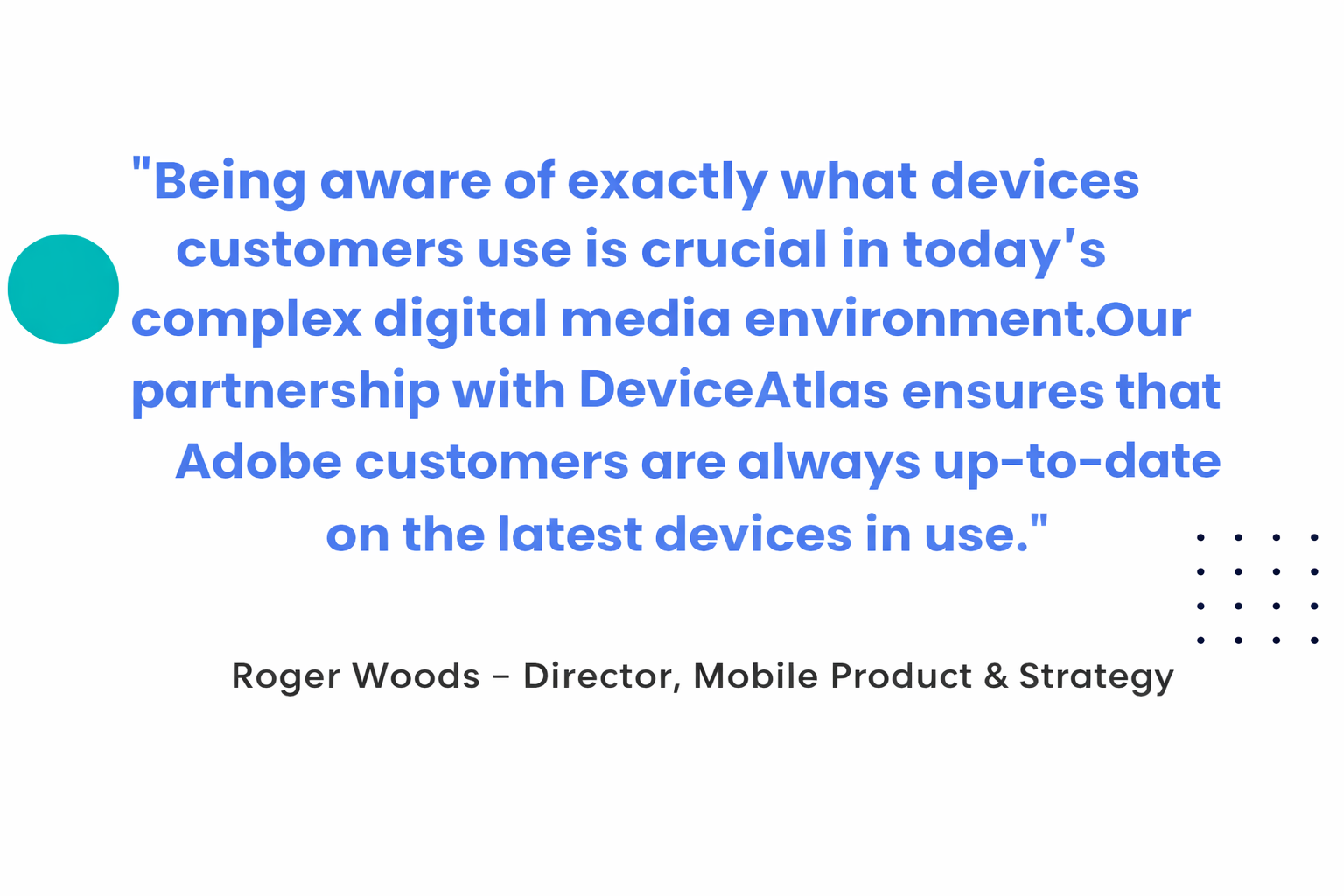
Leading platforms such as Adobe rely on DeviceAtlas to ensure accurate device-level insights. Their global customer base depends on this vital intelligence to fully understand what their customer’s device preferences are and react to them in real time.
To learn more about DeviceAtlas’ leading role in device intelligence, check out our blog Device Intelligence: The Missing Piece in Your Growth Strategy, written by our Director of Product Strategy, John Leonard.
Conclusion
In a rapidly evolving digital world, it is essential that organizations acknowledge the importance of device intelligence in their business growth strategy. The first step is choosing a device intelligence solution that doesn’t require engineering efforts, can handle high-traffic, and provide accurate device identification. For most enterprises, their future success lies in partnering with trusted providers like DeviceAtlas who consistently deliver accuracy, performance, and confidence at scale.